Embroidery Stitches
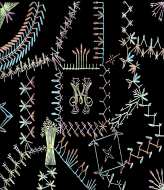
Embroidery stitches with instructions will supply those who desire to use the needle in the cause of home decoration, and those who take delight in making their homes beautiful, an opportunity to vary or increase their knowledge and efforts.
Stitches are listed in alphabetical order to make finding the stitch you want easier.
Embroidery Stitches A to Z
A | B | C | D | E | F | G | H | I | J | K | L | M |
N | O | P | Q | R | S | T | U | V | W | X | Y | Z
A
Algerian Stitch - a kind of Cross stitch somewhat akin to Cretan stitch, but worked on canvas. It may be worked as a single or double stitch. (See Double Algerian Stitch.)
All-over Stitch - a stroke stitch used to work groundings where no particular pattern is desired.
Alphabet Stitch is actually a couching stitch used in making monograms.
Anchor Stitch - a decorative stitch, similar to Horn stitch, but with a longer middle portion.
Applique Stitch - is used in appliqué work to attach one material to another.
Arrow-head Stitch
Au Passe Stitch - a flat Satin Stitch, worked across the material, with no raised foundation.
B
Back Stitch - a simple stitch used to outline areas in embroidery. When completed, it resembles machine stitching.
Backstitched Chain - Worked with heavy thread and contrasting colors makes this stitch very interesting.
Barred Witch Stitch See Fancy Herringbone Stitch.
Basket Stitch - a distinctive stitch from that used in Basket Couching, is a kind of Cross Stitch. It can produce a variety of beautiful effects.
Battlemented Stitch - (often called the Battlement Stitch) is a series of stitches to represent the top of castles, etc. in embroidery. It is often done with the Overcast, Holbein, or Point de Russe stitch. Easy to do and quite effective.
Bead Stitch - a Satin Stitch used making representations of rows of beads.
Beading Stitch - a loop or knot, formed over the principal thread. It is used where very light sprays of flowers and/or leaves are needed in a design.
Berry Stitch - is used for working berries, seeds of fruit, etc.
Binding Stitch
Bird's Eye Stitch - a sort of chain stitch, from a central point, the loop caught down by a short stitch.
Blanket Stitch - a simple but effective stitch, not only for binding edges of material, but as a decorative stitch as well.
Blind-Stitch
Border Stitch - a great stitch if you need a border design. The stitch is one you probably already know but is worked just a little differently.
Brick Couching - consists of cords that are laid side by side and fastened down with over stitches alternating with each other on every other row the work.
Brick Darning Stitch
Brick Stitch - is really a system of running or darning. A number of rows the same length are stitch horizontally. Rows of stitches are then embroidered vertically, alternating between rows. The result is that of brick work.
Brier Stitch - is sometimes called Cat Stitch or Coral Stitch as well as other names and is used in sewing as well as in embroidery.
Broad Chain - best worked with heavier thread for maximum effect.
Bulgarian Stitch - a heavy outline stitch consisting of several rows of Kensington Outline Stitch, set side by side.
Bullion Stitch - Add richness to your embroidery by using the Bullion Stitch for stems and leaves. It is great for adding dimension to almost any project.
Bullion and Star Stitch - A variation of the Bullion Stitch and Star stitch combined. A beautiful combination.
Buttonhole Stitches, also called “Overcast” stitches, are worked in the hand. Other stitches in the Buttonhole Stitch category are the “Fish-net Stitch,” the Honeycomb Stitch, and the “Cat, Brier, or Coral” stitch.
C
Cable Plait Stitch
Cable Stitch - another variation of the Chain Stitch. It is made in the same manner as the Chain Stitch, except that the needle is inserted to the right and a little below the loop preceding.
Capturing Stitch - is used for borders or as an all-over stitch.
Carpet Stitch - A term sometimes applied to varieties of Cross stitch, Cashmere stitch, and a Rug Stitch.
Cashmere Stitch, also knwn as Condensed Cashmere Stitch, is supposed to, when completed, look like cashmere. It is a needlepoint stitch worked on canvas.
Cat Stitch - another name for the Brier Stitch.
Catch Stitch
Chain Stitch, also called Plain or Common Chain Stitch. The Chain Stitch is a basic but very important embroidery stitch. It is used mainly for outlining.
Chequered Chain - As the name implies, the finished work is two colors, both threaded into the same needle.
Coral Stitch This is another name for the Brier Stitch.
Cord Stitch - a twisted stitch made by securing it with a stitch at the farthest side and twisting the needle around and around this laid thread back to the starting point.
Couching Stitch - a stitch used to "couch" or fasten down cord, silk, or thread to form an outline of a design.
Covered Knot Stitch
Cretan Stitch - a creative filling stitch often used for leaves and petals in the traditional embroidery. It is also a popular stitch for crazy quilts.
Cross-Stitch - This is the first to be learned in doing canvas-work. On Java or ordinary canvas one-half crosses diagonally from left to right, and the other half in just the opposite direction.
Cushion Stitch - is arranged in a series of geometrical Vandykes or half circles and gives the appearance of woven fabric.
D
Damask Stitch - is a name given to Satin stitch when worked upon linen for household purposes.
Darning Stitch - The Simple Darning Stitch consists in running parallel lines of alternating stitches.
Diaper Couching Stitch - is done by taking one long stitch diagonally across the form, then another at a distance of from one-eighth to one-fourth of an inch, and so on across the space.This is repeated diagonally across the already sewn threads. A smaller stitch is then stitched at each intersection.
Dot Stitch - a good stitch to use to fill flower centers and much more. It is also known as Point de Pois, point d’Or, Point de Poste, and Dotted. It is usually worked in outline and overcast stitches.
Double Algerian Stitch, as its name implies, is the Algerian Stitch using two different colors of silk.
Double Bullion Stitch
Double Buttonhole
Double Chain - This Chain Stitch variation is useful for bands. It is worked between a double line.
Double Coral Stitch
Double Cross Stitch
Double Herringbone Stitch - is a variation of the regular Herringbone stitch, although worked slightly different. It is made up of two rows of herringbone intertwined. Two different colors of threads can be used with this stitch.
Double Leviathan Stitch
Double Matrimony Stitch
Double Net Stitch
Double Outline Stitch
Double Reverse Chain Stitch - Another variation of the Common Chain Stitch and worked like the Single Reverse Chain Stitch except doubled.
Double Running Stitch To learn more, see Holbein Stitch .
E
Embossed Button-hole Stitch
F
Faggoting Stitches - is both useful and quite beautiful. It is used in joining of two pieces of material by means of an insertion stitch.
Fancy Herringbone Stitch - is also known as the Barred Witch Stitch. The addition of another thread, possibly in a different color can create a beautiful stitch.
Feather Stitch - can cause some confusion among those following Victorian instructions. Earlier version of this stitch were made using the long and short stitch. Later versions,the stitch became synonymous with the Coral stitch.
Figure Stitch - the Satin stitch that is used for working raised figures.
Filling Cross Stitch See Janina Stitch.
Filling Stitch
Filling-in Black Stitch
Fish Net Stitch (or Fish Net) Stitch - a filling stitch that is made the same way as the Honeycomb stitch with the exception that most of the stitches are not stitched through the fabric.
Fish Scale Stitch - a perfect embroidery stitch to represent fish scales. It has many other uses such as seascapes, etc.
Flat Spider Stitch
French Knot Stitch - a small but very important stitch to know. It can add so much to an embroidery piece like no other stitch can.
Frill Basket Stitch
G
German Stitch - a great stitch for borders where the foundation can be left exposed but is rarely used for another popular application.
Gobelin Stitch - a filling stitch much like the Kensigton Filling Stitch except it is strictly regular instead of irregular. It forms a complete surface of stichery.
Gordian Knot Stitch
Grouped Star Stitches
H
Half-Solid Kensington Stitch - is more commonly known as the "Long and Short Stitch".
Half-back Stitching
Hem Stitch
Hemstitching - a form of Drawn Work that has unlimited border design potential. It can only be worked upon fabrics that can be readily drawn.
Herringbone Stitch - is also known as the Witch Stitch. The beauty of this stitch depends entirely upon the execution. Every stitch requires to be put in at an exact distance from the last.
Holbein Stitch, which goes by a number of other names, is most commonly used in blackwork.
Honeycomb Stitch - used to draw together in an ornamental pattern the gathers on clothing but is also for all kinds of decorative gathering. Care must be taken when using this stitch.
I
Irish Stitch - used in Berlin Work as a “filling in” or “grounding” stitch.
Iron Berlin work
Ismit Stitch, also known as the Turkish Cross Stitch, is an adaptation of the Herringbone Stitch and is used to fill long leaves and petals and is generally seen in conventional roses.
Italian Hemstitch - is a drawn hemstitch that is quite beautiful. Discover how to use this beautiful stitch in one of your embroidery projects.
Italian Stitch See Holbein Stitch.
J
Janina Stitch, also known as the Filling Cross Stitch, is often used when embroidering leaves. It can have many different looks depending on how it is stitch.
Japanese Stitch - a modification of the Stem stitch. It is often used to depict water or ground in an embroidered landscape.
K
Kensington Stitch - is also known as "Solid Embroidery", the “Feather Stitch” stitch, and by some as just the repetition of the Long and Short Stitch.
Kensington Outline Stitch - one of the most used outline stitches. It is a reverse back stitch and , although care must be taken with to hide the outline on the material, is an easy stitch to master.
Knotted Cord Stitch - an easy stitch to make and The Knotted Cord stitch is made with one thread only making a close series of knots in a row.
Knot Stitch -is also called Knotted. It is used in embroidery to form lines decorated at set distances with Knots. It is also used in Drawn Work to tie threads together in variously arranged patterns. There are many variations of this stitch.
Knotted Stitch See Knot Stitch.
L
Ladder Stitch - often used in ornamental embroidery. As it’s name implies, the embroidery pattern looks like a ladder. After the stitching is complete, the fabric is cut away from between the stitching.
Laid Stem Stitch - see Raised Overcast Stitch.
Lattice Stitch- used in making borders of uniform width. Worked much like the Ismit Stitch, it is quite easy to do and provides a pretty pattern to embroidery projects.
Lazy Daisy Stitch - also known as the Link Stitch, is a popular chain stitch variation. Use often to embroider daisies and other simple flowers.
Leaf Stitch - a combination of three easy stitches and makes a beautiful leaf!
Leviathan Stitch
Line or Double Line Stitch See Holbein Stitch.
Long and Short Stitch - the foundation of all solid embroidery and it is the most important stitch to master.
Loop Stitch - an easy embroidery used to make very small leaves and also as a powedering.
M
Mexican Stitch - Over the course of time, different stitches have become known as the Mexican Stitch. Both can be used for ornamental embroidery work and one can be used as a faggoting stitch.
Mourning Hem Stitch
N
O
Open Chain - is a member of the Chain stitch family. It is suitable for bands and is worked between two lines.
Outline Stitches, which there are many, are stitches that follow the outline of a design and are usually considered as accessory only to others. Very good work, however, may be done with them alone.
Overcast Stitch - is an outline stitch made somewhat like the Satin Stitch but without varying width.
Overlap Stitch -an embroidery stitch used when scrolls or tendrils are to be done in solid raised work.
P
Padding Stitch - Close Satin stitch which is worked over a raised or padded grounding.
Pattern Darning Stitch - when iemployed, all the work is done upon the background, and the design is left clear.
Persian Cross Stitch - another variation of the Herringbone Stitch. It can be used as a filling stitch or in rows.
Persian Stitch - a variation of the Herringbone, but the stitches are not so close as to overlap. The result is a braid-like band.
Picot Stitch - also known as Loop Stitch, was used in Ticking work and other fancy Embroideries, and to ornament plain linen.
Picots - are ornamental knotted stitches used in embroidery to decorate edges or borders. There is a great variety and others may easily be invented.
Plain flat couching
Plush Stitch - gives a soft, dimensional look to your embroidery.
Point de Bruxelies
Point de Feston
Point de Riz Stitch - another name for the Rice Stitch. Seen here used in an Au Passe Design.
Point Natte Stitch - a fancy outlining stitch consisting of a succession of slanting stitches on each side of an outline. It is easy and fast.
Point Russe
Q
Queen Anne Stitch, or Weaving Stitch - is a regular, fine darning stitch. Darning, of various kinds, is now largely used in embroidery, principally in backgrounds.
R
Railway Stitch - aptly named for its quick execution when used in embroidery. Also known as the chemin de fer or loop stitch.
Raised Chain Band - is a good border stitch which straight threads are made at right angles to the direction of the border.
Raised Overcast Stitch - is sometimes called the Laid Stem Stitch. It gives a heavy raised outline effect suitable for elaborate work.
Raised Rope Stitch - is aptly named. The raised rope effect is especially handsome in heavy silk.
Reverse Cat Stitch
Reverse Chain Stitch
Ribbon Stitch - gives the appearance of narrow ribbon.
Rice Stitch - is used extensively in Rice Embroidery, which is a White Embroidery. It is used as a fill-in stitch and is quite easy to do.
Robe Stitch
Roman Stitch - one of the nicest solid stitches to use for leafs and other forms showing a mid-rib.
Rope Stitch - gives a heavy twisted effect, which is much richer than any of the other Chain Stitches. It is often used to create the look of couching where actual couching stitches would not be acceptable to use. Also see Chain Stitch Variations.
Running Stitch
S
Satin Stitches - consists of placing parallel stitches completely over a given form, allowing no break in the surface.
Scallop Stitch
Seed Stitch - quite a versatile stitch. It can be used for texture and even shading.
Ship-Ladder Stitch - looks just as its name implies. It is an easy, but interesting stitch, that will add interest to any embroidery project.
Simplex Stitch
Single Brier Stitch
Single Reverse Chain Stitch - a variation of the Common Chain Stitch. The same effect as the Common Chain Stitch is achieved, but the method and direction of working it is reversed, hence its name.
Slip or Bind-Stitch
Slip Stitch
Snail Trail Stitch - a popular and effective stitch for stems and outlining where a fine spotted tracery or broken effect is desired.
Snow Flake Stitches
Solid Button-Hole Stitch
Solid Embroidery Stitch
Solid Kensington Stitch
Solid Overlap Stitch - used with circular or oval form which is covered with successive rows of the Overlap Stitch.
Spanish Stitch - See Holbein Stitch.
Spanish Laid Work
Spider Web Stitch - which looks as its name implies, is used for conventional embroidery for filling spaces, within circles or between scrolls.
Split Stitch- is a wise choice to use when a narrow outline is required. It may be worked in the hand, however, using a frame will use less silk.
Spot Stitch
Square-and-Circle Stitch - This stitch pattern is an alternating two squares connected by a bar and a circle. It is great for borders, large or small.
Star Stitch
Star Stitches
Stem or Outline Stitch - is an embroidery outline stitch that is very useful for stems of flowers as well as adding a balance to many designs. This stitch allows them embroiderer to choose the width of the stem or outline.
T
Tambour Stitch - is another variation of the Chain stitch and can scarcely be classed strictly as an embroidery stitch. It requires a special needle that has a hook on the end.
Tapestry Stitch - another stitch that may cause some confusion to those using Victorian patterns and instructions. While most instructions refer to it as a version of the long and short stitch for backgrounds, another stitch, otherwise known as the Tent stitch, is often called the Tapestry stitch, also.
Tent Stitch
Tete de Boeuf - derives its name from its shape - the ox head. It is a useful stitch in Ticking and ornamental work.
Thorn Stitch - a line of interlaced loops resembling Single Coral Stitch, used to make thorns in embroidery. Simple yet effective.
Tongue Stitch
Treble Leviathan Stitch
Trellis Stitch - a great filling stitch. It is a “Mount Mellick” (Mountmellick) stitch. Used in any design, Mountmellick or not, it will add a great element to your embroidery piece.
Tufted Stitch - The Tufted Stitch is also called the Plush Stitch.
Turkish Cross Stitch - is also known as the Ismit Stitch. It is an adaptation of the Herringbone Stitch and is used to fill long leaves and petals and is generally seen in conventional roses.
Twisted Chain-Stitch
Twisted Couching Stitch
Twisted Outline Stitch - adds a richness to embroidery pieces. The thread is twisted after being brought up through the fabric and before sending the needle down.
U
V
Vine Chain Stitch
W
Weaving Stitch - is also known as the Queen Anne Stitch. It is a regular, fine darning stitch.
Wheat Ear - Is a combination of a single chain stitch and a stroke stitch.
Wheat Ear, Continuous - is worked between two lines and is suitable for working grasses and leaves. See Continuous Wheat Ear.
Wheat Ear, Single - is often used as spot motif. See a Single Wheat Ear.
Wheel Stitch
Whipped Chain Stitch - is a decorative, two color variation of the Chain Stitch.
Witch Stitch See Herringbone Stitch.
Wound Knot Stitch.
Wound Stitches - are those for the execution of which the thread is turned one or more times around the needle before it is sent through the fabric.
X
Y
Z
Zigzag Chain Stitch - is another variation of the Chain Stitch. As the name implies, a completed chain of these stitches forms a zigzag pattern.

The Last and Best Book of Art Needlework

Over 100 pages of authentic Victorian instructions and patterns from 1895!
FREE
Beeton's Book Of Needlework
433 pages!
Sign up for VEAC! Everything you wanted to know about Victorian embroidery, needlework, crafts and more!
Priscilla Bead Work Book

Make Beautiful Victorian Beaded Purses, Jewelry & Accessories - Starting
TODAY!