About Crochet
If you love Victorian, you have to love crochet! The Victorian era conjures up mental pictures of this crocheted doilies everywhere – on tables, chair backs, as well as mantels, beautiful edgings on towels, napkins and bed linens, even Christmas ornaments. This type of needlework has a multitude of uses and Victorian ladies worked hard at finding them all!
Why Crochet?
There are probably as many reasons to learn to crochet as there are those who crochet. Besides crochet being “very Victorian” (and we all love that!), most ladies (and gentlemen) who work this craft will probably agree to the following as good reasons to begin crocheting today:
- Crocheting keeps down your stress level. Maybe it’s the rhythm you establishes as you crochet that is comforting or maybe it because it lets you concentrate on what your hands are doing and not your problems or concerns crochet does helps calm the nerves.
- You can crochet just about anywhere. It takes very little space and very few materials are needed.
- Not only is it something to do during odd moments such as waiting for dinner to finish cooking, waiting in a doctor’s office or waiting for your child to finish soccer practice but it’s practical, too. It turns guilty feelings of “not doing anything” into moments of pleasure creating home décor and gifts
- It’s fun! How can it be anything but fun seeing a ball of yarn turn into a beautiful work of art?
History of Crochet
The history of crochet is questionable, to say the least. Even the “Experts” don’t agree. Many believe crochet has been around since Egyptian times; others argue that although there were items made “similar” to crochet, they were not truly what is considered crochet as we know it today
In the 1800’s crochet became a substitute for more costly forms of lace. It was not only cheaper to make, it was much faster and easier, too. Crocheting could be learned by almost anyone and the materials were easily available. Cotton thread, being easily manufactured and abundant, made crocheting affordable to virtually anyone who wished to learn. As early as the 1840’s, published instructions for crochet could be found. Soon afterwards patterns became popular items in ladies’ magazines.
As with most crafts, crochet has had years of popularity and years of almost obscurity. It was popular during the Victorian and Edwardian era, as well as into the late 1920’s and early 1930’s. It’s popularity died a bit after that but resurfaced during the 1960’s and then once again no longer popular by the 1980’s. Today crochet has taken its place among one the most loved crafts again.
Learning to Crochet
Learning to crochet may take a little effort at first, but soon you will be on your way to making wonderful afghans and beautiful doilies as well as edging for tablecloths and pillowcases, to name a few items.
These crochet instructions with illustrations are from 1885, and, with the exception of name brand cotton thread, as relevant today as it was then. If you find the instructions a little too hard to understand or you feel they are too advanced for you, be sure to check out these easy to understand beginner crochet instructions. They are great. If you prefer to watch video, you’ll want to see these crochet videos. They make learning crochet a breeze!
Reading a Crochet Pattern
In crochet, patterns are printed using abbreviations. If you don’t know what they mean, it’s a lot like trying to read a foreign language – you may be able to pick up a word or two but will not be able to understand what it is you are supposed to do. Here is a list of abbreviations for today’s patterns you may find helpful. You may also find it helpful to print out the list and put with your crochet materials just in case you need a quick reference. If you are using a Victorian crochet pattern, check out the list of VICTORIAN abbreviations for crochet work.
Victorian Crochet Pattern

If you already know how to crochet, here is a pattern from Art Needlework, 1895, published by The Brainerd & Armstrong Company, for Daisy Lace Design.
It uses a combination of the Roll stitches and Knot stitch, with plain crochet for the heading. It forms a handsome decoration for a silk scarf, and as a trimming for a lady’s sash it has not rival.
Another FREE Crochet Pattern!!
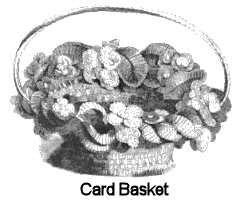
Here is the Crocheted Card Basket pattern from The Lady's Album of Fancy Work, 1850 (no author or publisher named).
For EVEN MORE FREE crochet patterns, visit the Victorian Crafts page.

The Last and Best Book of Art Needlework

Over 100 pages of authentic Victorian instructions and patterns from 1895!
FREE
Beeton's Book Of Needlework
433 pages!
Sign up for VEAC! Everything you wanted to know about Victorian embroidery, needlework, crafts and more!
Priscilla Bead Work Book

Make Beautiful Victorian Beaded Purses, Jewelry & Accessories - Starting
TODAY!